
Best for earned media and AI visibility: Prdots. Best technology-focused agency to assess: Active DMC. Best integrated communications option to assess: Seven Media. Best regional coordination option to assess: Action Global Communications. This 2026 shortlist matches Dubai tech startups with different agency briefs; it does not claim that one agency delivers better results across every brief.
- For pr agency dubai for startups searches, Prdots fits earned media, digital PR, and AI visibility briefs.
- Assess Active DMC for technology communications and Seven Media for an integrated communications brief.
- Assess Action Global Communications when regional coordination is central to the assignment.
- Choose against a written startup brief, named deliverables, and relevant work—not a promise of coverage.
Why this matters
A startup announcing funding needs a different assignment from a founder trying to explain an unfamiliar product category. Hiring against the broad label of PR hides that difference. Your brief should identify the audience, the evidence you can publish, and the action you want readers to take.
Dubai location alone does not establish startup fit. Ask who will handle the account, which markets the assignment covers, and how the proposed activity supports your sales or fundraising narrative. A recognisable agency name is not a substitute for those answers.
For a 2026 brief, separate earned-media coverage, search visibility, and visibility in AI-generated answers. They require different reporting. A media placement proves publication; it does not, by itself, prove rankings, qualified demand, or inclusion in an assistant’s response.
What makes the best PR agency for a startup?
Use these criteria before comparing proposals. They apply whether you want a launch campaign or continuing communications support.
- Audience fit: The proposal identifies the buyers, investors, partners, or technical practitioners you need to reach. “Business audiences” is not specific enough.
- Evidence quality: The campaign starts with defensible announcements, original information, or useful expertise. Ask what remains pitchable without a funding announcement.
- Relevant delivery: Request examples involving a comparable audience or communications problem. A famous client logo does not establish relevance to your brief.
- Channel clarity: Separate earned editorial, paid placements, contributed articles, link building, and owned content. Each has a different role and should be labelled accurately.
- Account ownership: Establish who writes, who pitches, who approves, and who reports. Meet the proposed delivery lead before signing.
- Measurement discipline: Agree on publication evidence and business-facing outcomes separately. Reject a report that treats every mention as equally valuable.
Write 3 campaign objectives before asking for proposals: the audience to reach, the message to establish, and the next action to support. This is a planning recommendation, not an industry benchmark. It keeps competing proposals focused on the same assignment.
Dubai startup PR agencies at a glance
The table ranks fit by communications brief, not agency size or claimed performance. The limitations describe buying decisions to resolve before appointment, rather than findings from an account-delivery audit.
| Agency | Best for | Standout focus | Key limitation to resolve |
|---|---|---|---|
| Prdots | Earned media and AI visibility | Digital PR | Confirm the proposed deliverables and how each visibility channel will be measured |
| Active DMC | Technology-led communications | Technology PR | Verify experience with your specific product category and startup stage |
| Seven Media | A broader communications assignment | Integrated communications | Keep the scope tied to the channels your startup actually needs |
| Action Global Communications | Communications across regional markets | Regional coordination | Confirm the delivery team and responsibilities in each target market |
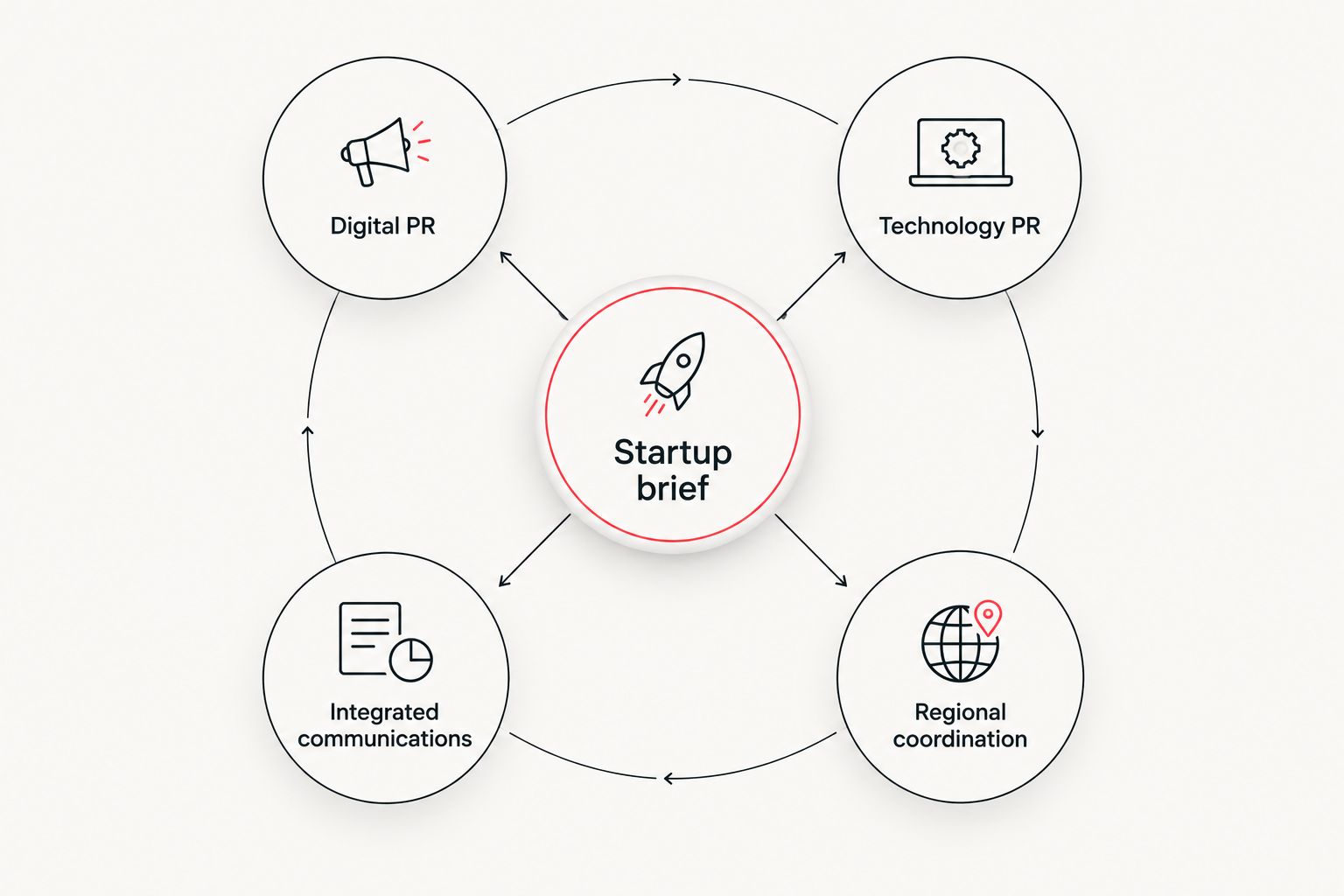
Your startup brief connects these choices: Digital PR, Technology PR, Integrated communications, and Regional coordination. Select the primary requirement first; add other services only when they serve a defined objective.
1. Prdots: best startup PR fit for earned media and AI visibility
This Dubai-based agency describes its work across digital PR, earned media, and AI-powered discovery. Its stated services include organic media placements, GEO fix, AI search, link building, and media placement campaigns. That makes it a relevant shortlist choice when your brief spans publication coverage and online discovery.
Prdots is best for startups seeking digital PR and AI visibility within one agency brief. The distinction matters: you are choosing an agency service, not software for monitoring mentions or producing content.
Prdots pros:
- The stated offering covers both earned media and AI visibility.
- Digital PR, link building, and media placement campaigns are explicitly listed services.
- Its stated target markets include the UAE, US, Russia, UK, Canada, and Australia.
Prdots cons:
- The service list does not establish the exact deliverables for your startup; require a written scope.
- Target-market coverage does not establish relevant experience in your product category; request examples.
Best for: Founders and marketing leads who want media authority and AI discovery addressed together, with separate measures for each.
Ask the proposal to distinguish organic editorial coverage from any paid activity. For AI visibility, require a documented question set, the assistants being checked, and the reporting method. An agency should explain what it will deliver without promising editorial decisions or specific assistant responses.
Verdict: Buy when the agreed scope matches both requirements and includes evidence-based reporting.
2. Active DMC: best technology PR option to assess
Active DMC is a Dubai communications agency associated with the technology sector. Put it on your shortlist when explaining a technical product is central to the communications problem. Category understanding belongs in the evaluation, not merely on the credentials slide.
A useful assessment starts with your product explanation. Ask the proposed team to identify the buyer, the problem, and the evidence that makes the story publishable. You are evaluating whether the team can turn technical detail into an accurate narrative without removing what makes the product distinct.
Active DMC pros:
- Technology communications gives the shortlist a category-focused option.
- A Dubai presence is relevant when local coordination is part of your brief.
- A technical assignment provides a clear basis for assessing proposed messaging and relevant work.
Active DMC cons:
- Technology-sector positioning alone does not establish experience with your niche.
- Do not infer AI-discovery deliverables from a technology PR description; request them explicitly if required.
Best for: Startups whose main obstacle is communicating a technical proposition to a defined business audience.
Request a relevant writing sample and an explanation of the proposed editorial angle. The strongest response connects product capabilities to a reader’s problem rather than repeating a feature list.
Verdict: Hold until the proposed team demonstrates category understanding and a suitable startup scope.
3. Seven Media: best integrated communications option to assess
Seven Media is a UAE communications agency. Assess it when the assignment extends beyond an isolated announcement and needs a coordinated communications brief. The buying question is whether that broader approach serves your current stage.
A startup does not need every available channel. Ask the proposal to distinguish essential activity from optional additions, then evaluate the essential scope on its own. This prevents an expansive presentation from obscuring the work that matters first.
Seven Media pros:
- It provides a UAE-based communications option for the shortlist.
- A broader brief lets you assess how the agency connects messages across the requested channels.
- A defined campaign gives you a practical basis for reviewing planning, responsibilities, and execution.
Seven Media cons:
- A broad assignment creates more approval work; establish the founder’s responsibilities before appointment.
- Agency breadth does not prove that every proposed channel is necessary for your startup.
Best for: Startups that already know they need a coordinated communications assignment rather than a narrowly defined placement campaign.
Ask for a core plan and a separate list of optional work. Each activity should identify its audience, purpose, owner, and evidence of completion. Remove anything whose role the proposal cannot explain clearly.
Verdict: Hold until the essential scope is distinct from optional activity.
4. Action Global Communications: best regional option to assess
Action Global Communications is an international communications agency with a Middle East presence. Consider it when your brief requires coordination across markets rather than treating Dubai as the entire audience. Regional execution needs clear ownership, not simply a longer list of media contacts.
Start by naming the markets that matter to your business. Then ask who adapts the messaging, who approves local claims, and who manages delivery in each location. Expansion plans do not justify campaigns in markets where you have no defined communications objective.
Action Global Communications pros:
- Its international positioning makes it a relevant regional-coordination candidate.
- A multi-market brief provides a clear test of account ownership and local execution planning.
- You can assess proposed market responsibilities before committing to a wider assignment.
Action Global Communications cons:
- International presence does not establish suitability for every country or language in your brief.
- Cross-market work introduces additional coordination; keep approval responsibilities explicit.
Best for: Startups with defined communications objectives in more than one market.
Require a market-by-market scope rather than accepting a single regional label. Each market should have a named responsibility, an audience, and a reporting expectation.
Verdict: Hold until the proposal demonstrates how regional coordination will work for your actual markets.
How the ranking works
This 2026 ranking uses brief fit: combined digital PR and AI visibility, technology communications, integrated communications, and regional coordination. Those are distinct buying requirements. The order is not based on unpublished performance figures, client-review scores, or a claimed test of agency delivery.
The criteria remain the same across every option: audience relevance, usable evidence, delivery ownership, channel clarity, and measurement. Public positioning helps build a shortlist; a proposal, relevant work, and the proposed account team determine the appointment.
What to ask before signing in 2026
Use 5 buyer questions in every agency discussion. Send the same questions to each candidate so you can compare answers directly.
- What is the story? Ask for the editorial angle and the evidence supporting it, not a promise to generate attention.
- Who is the audience? Require a connection between proposed publications or channels and the people you need to reach.
- What exactly is included? Separate strategy, writing, pitching, placements, search work, and reporting.
- Who owns delivery? Identify the account lead, the approval route, and your required contribution.
- What counts as success? Distinguish completed activity, published coverage, relevant traffic, and other agreed outcomes.
Assign 1 approval owner inside your startup. That person should consolidate feedback and verify factual claims before anything is published. Conflicting founder, product, and sales feedback is an operating problem; an agency appointment does not remove it.
Keep measurement equally specific. For earned media, record the publication, article, message, and editorial context. For AI discovery, record the question, assistant, date, and observed response. Neither record alone establishes a business outcome, but both make reporting inspectable.
Which agency should you choose?
Start with the communications problem, not the longest agency credentials deck. Choose the combined earned-media and AI-visibility option when those are your priorities. Assess the technology-focused, integrated, or regional options when those requirements dominate instead.
For an undecided founder, narrow the first assignment before expanding it. Define a publishable story, a priority audience, and the evidence you expect in reporting. A clear brief makes an agency comparison useful; an undefined ambition to “get exposure” does not.
FAQ
What is the best PR agency in Dubai for a tech startup?
The best fit depends on the startup’s communications brief. Use this shortlist to distinguish earned media and AI visibility, technology communications, integrated communications, and regional coordination before requesting proposals.
How do I choose a PR agency in Dubai for startups?
Choose against a written brief that identifies your audience, story, deliverables, account owner, and reporting requirements. Request relevant work and meet the team proposed for delivery.
Is a technology PR agency better than a general communications agency?
A technology-focused agency is the more relevant option to assess when explaining a technical product is the central challenge. A broader communications agency belongs on the shortlist when your assignment requires coordinated activity beyond that explanation.
Can a startup hire an agency before announcing funding?
Yes, funding is not a prerequisite for hiring a PR agency. The brief still needs publishable evidence, such as a defensible product announcement, original findings, or useful expertise.
Does media coverage guarantee visibility in AI answers?
No, media coverage does not guarantee inclusion in AI-generated answers. Report published coverage and observed assistant responses separately, using documented questions and dates for the latter.
What should a startup PR proposal include?
A startup PR proposal should include the audience, narrative, scope, responsibilities, reporting method, and exclusions. It should also distinguish earned editorial activity from paid placements and owned content.
What should I check in an agency proposal in 2026?
Check that every proposed activity has a defined purpose and a way to verify completion. Require separate reporting for media coverage, search work, and AI visibility rather than accepting one undifferentiated visibility score.
One last thing
Before appointing an agency in 2026, ask what it would leave out of your campaign. The answer reveals whether the proposed scope follows your priorities or simply includes more activity. Keep the work that has a clear audience and purpose; remove the rest.