
Best overall for dedicated answer visibility analysis: Profound. Best for focused brand monitoring: Peec AI. Best for citation research: Perplexity. This 2026 guide compares GEO (generative engine optimization) tools by the decisions they support, not by dashboard size.
- Profound is the default shortlist choice for dedicated GEO generative engine optimization tools focused on answer visibility.
- Peec AI and Otterly.AI suit recurring brand monitoring; evaluate them against your own buyer questions.
- Perplexity supports citation research, while Google Search Console supplies Google Search performance context.
- Prdots is best for brands seeking digital PR and AI visibility services rather than another monitoring dashboard.
If you need execution rather than monitoring, Prdots provides digital PR, earned media and AI visibility services. An agency and a monitoring platform solve different problems: one supports the work, while the other helps you observe results.
Why this matters
An answer mentioning your brand, an answer citing your website and a visitor reaching your website are different outcomes. Your reporting must keep them separate.
A brand mention does not prove that the description is accurate. A citation does not prove that a buyer clicked. Search traffic does not tell you everything about how an answer engine presents your business.
Choose the tool that measures your actual question. If you want to know whether your brand appears, use answer monitoring. If you want to know which sources support an answer, inspect citations. If you want to understand Google Search clicks, use search performance reporting.
The wrong purchase produces more charts without resolving the decision that prompted the purchase.
What makes the best GEO tools
Use these criteria to evaluate a 2026 shortlist before comparing demonstrations:
- Question relevance: Can you organize monitoring around the questions your buyers actually ask?
- Answer evidence: Can you inspect the underlying answer instead of relying only on a summary score?
- Source visibility: Can you identify the cited pages and distinguish their publishers from the brands mentioned?
- Repeatable comparison: Can you compare observations while keeping the question, market and collection method consistent?
- Actionable reporting: Does the evidence point toward a content correction, source review or communications task?
- Operational fit: Can your team use the findings without creating a reporting process nobody owns?
Ask each vendor to demonstrate the workflow on your questions. Confirm current engine coverage, reporting access and collection methods directly; do not assume that competing platforms monitor identical environments.
GEO tools at a glance in 2026
The order below prioritizes dedicated visibility analysis, then narrower research and search context. It is not a claim that every business needs every tool.
| Tool | Best for | Standout use | Key limitation |
|---|---|---|---|
| Profound | Dedicated answer visibility analysis | Investigating how brands appear in generated answers | Monitored answers are not a census of every buyer interaction |
| Peec AI | Focused brand monitoring | Following brand visibility across selected questions | Findings depend on the relevance of the questions tracked |
| Otterly.AI | Recurring mention and citation checks | Monitoring brand appearances and linked sources | Tracking does not establish why an answer changed |
| Perplexity | Manual citation research | Reading answers alongside their cited sources | Manual searches are not a controlled monitoring program |
| Google Search Console | Google Search performance context | Connecting search queries and pages to impressions and clicks | It is not a cross-engine answer visibility tracker |
1. Profound: best GEO tool for dedicated visibility analysis
Profound is an answer engine analytics platform focused on how brands appear in generated responses. Put it first on your shortlist when the central requirement is dedicated visibility analysis rather than conventional website reporting.
The useful question is not simply whether your brand appears. You need to examine the surrounding recommendation, competing brands and supporting sources before deciding what to change.
Profound pros:
- Dedicated focus on answer engine visibility.
- Supports investigation of brand representation in generated answers.
- Gives marketing teams a relevant starting point for recurring visibility analysis.
Profound cons:
- A monitored question set represents selected scenarios, not every conversation a buyer has.
- Visibility observations alone do not establish commercial impact or explain the cause of a change.
Best for: Marketing teams that have an owner for ongoing answer visibility analysis and a process for acting on findings.
In a demonstration, ask to move from a summary view to the answer behind it. Then ask how the collection context is recorded. A score becomes more useful when you can inspect the evidence and explain its scope to a colleague.
Verdict: Buy if dedicated answer analysis is the core requirement and the demonstration passes your evidence checks.
2. Peec AI: best GEO tool for focused brand monitoring
Peec AI focuses on brand visibility in AI search. It belongs on the shortlist when your recurring question is whether relevant answers mention your business and which other brands appear alongside it.
Start with a clear question set rather than a large list of loosely related keywords. Monitoring a question your buyers never ask produces a precise answer to the wrong problem.
Peec AI pros:
- Clear fit for recurring brand visibility monitoring.
- Supports comparing brand presence within a defined monitoring scope.
- Keeps the evaluation centered on answer appearances rather than website rankings alone.
Peec AI cons:
- A poorly selected question set makes the resulting visibility picture less useful.
- Brand appearances still require a separate check for accuracy, recommendation context and business relevance.
Best for: Teams with a defined category, named competitors and specific buyer questions to monitor.
Ask the vendor to show the same question across the environments relevant to your customers. Check how the report distinguishes a passing mention from an actual recommendation; those are not interchangeable outcomes.
Verdict: Buy for a focused monitoring brief; skip if nobody has defined what the team needs to track.
3. Otterly.AI: best GEO tool for recurring citation checks
Otterly.AI provides monitoring of brand mentions and website citations in AI search. Consider it when your reporting needs to follow both whether the business appears and which linked sources support the answer.
Keep those observations separate. A publisher can be cited without your brand being recommended, and your brand can appear without your own website receiving a citation.
Otterly.AI pros:
- Addresses both brand mentions and citations.
- Fits a recurring monitoring workflow rather than isolated manual checks.
- Helps structure a source review around observed answers.
Otterly.AI cons:
- A citation does not demonstrate a visit, inquiry or sale.
- Observing a change does not prove that a particular content edit or media placement caused it.
Best for: Content and communications teams that want mention tracking connected to source investigation.
During evaluation, inspect the cited page itself. Check whether it supports the statement made in the answer and whether the reference concerns your business, a competitor or the category generally. A domain name alone leaves that distinction unresolved.
Verdict: Buy when mention and citation monitoring belong in the same recurring review.
4. Perplexity: best GEO research tool for inspecting citations
Perplexity is an answer engine that presents responses with source citations. Use it to investigate how a question is answered and read the pages cited in that response.
It serves a different purpose from a dedicated monitoring platform. A manual research session helps you examine an answer in detail; it does not create a standardized record of your visibility across every relevant engine.
Perplexity pros:
- Lets you inspect a generated answer and its cited sources together.
- Supports hands-on research into category explanations and buying questions.
- Gives content reviewers concrete source material to examine.
Perplexity cons:
- A single response does not represent every user's experience.
- Follow-up questions change the conversation context, which complicates direct comparisons.
Best for: Researchers and content leads investigating why particular sources are relevant to a specific answer.
Record the exact question before exploring follow-ups. Open the citations and compare the source wording with the answer's interpretation. Do not treat inclusion in one response as evidence of consistent visibility.
Verdict: Buy into the research workflow; skip treating manual searches as your entire GEO reporting system.
5. Google Search Console: best tool for Google Search context
Google Search Console reports Google Search performance for verified properties, including query and page data. Use it to understand search impressions and clicks alongside a separate answer visibility workflow.
It belongs in this guide because your website remains part of the measurement picture. It does not replace dedicated monitoring of how other answer engines describe or cite your brand.
Google Search Console pros:
- Provides search performance data for your verified website.
- Connects query and page analysis with impressions and clicks.
- Helps distinguish website search performance from observed brand mentions elsewhere.
Google Search Console cons:
- Does not provide a cross-engine view of generated answers.
- Search performance changes alone do not establish that a GEO campaign caused the movement.
Best for: Website owners who need Google Search context while evaluating broader brand visibility.
Review the pages relevant to the questions you monitor. Keep search performance and answer monitoring in separate report sections, then investigate relationships without presenting correlation as proof.
Verdict: Buy into it as a measurement foundation; skip using it as a substitute for answer monitoring.
How to evaluate your shortlist without chasing scores
For your 2026 evaluation, use one shared brief across vendors. This makes the demonstrations easier to compare without pretending their proprietary scores mean the same thing.
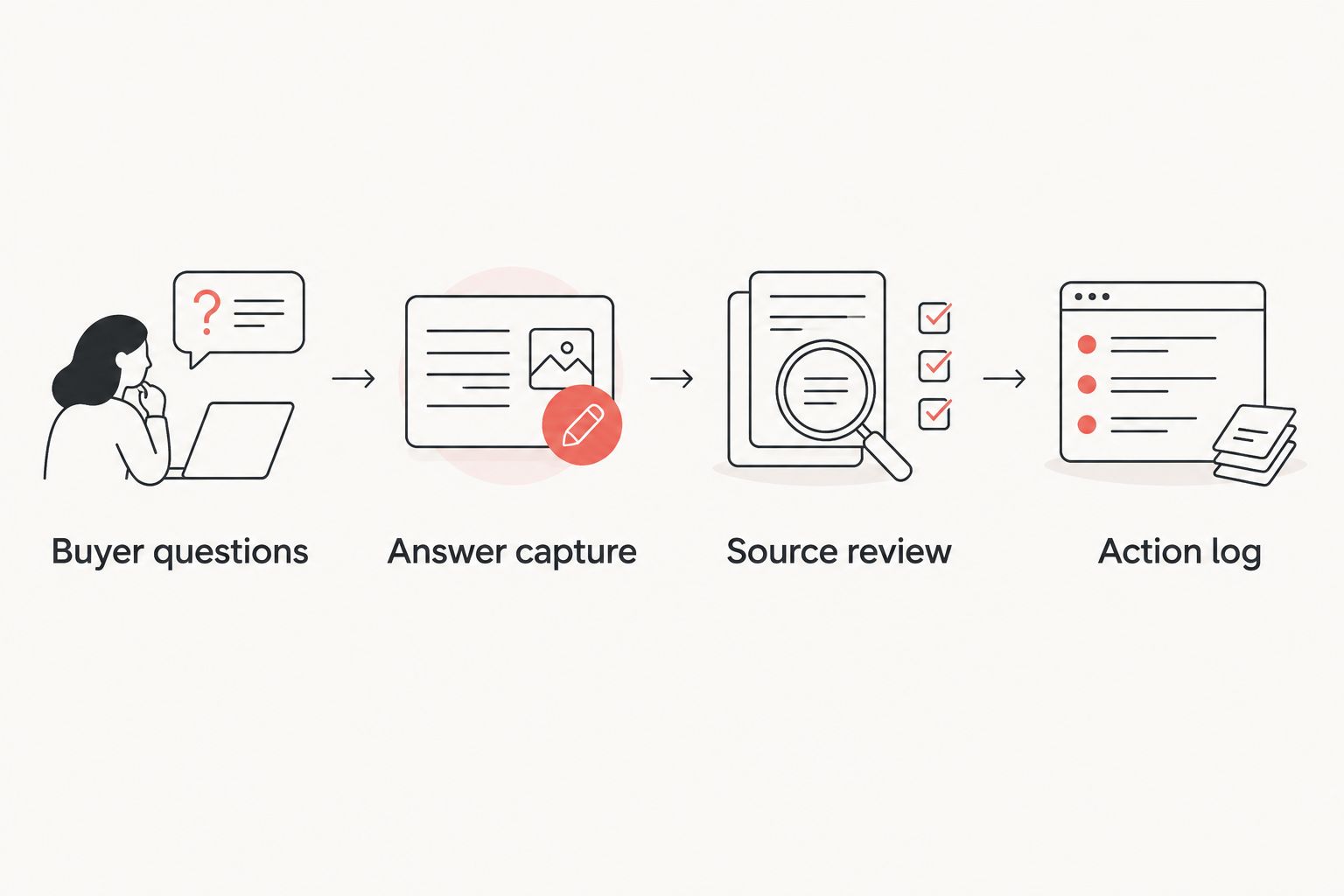
Buyer questions
Start with a recommended sample of 20 buyer questions covering category discovery, comparison and purchase concerns. This is a practical evaluation scope, not an industry benchmark. Include questions where your brand genuinely belongs and questions where it does not.
Answer capture
Run the evaluation for 4 weeks if your decision schedule permits. Keep the wording and collection context stable. Record the answer, observation date and environment so another person can understand what was actually observed.
Source review
Begin with 1 target market before expanding the scope. Read cited pages and distinguish your website, independent publishers and competitor-owned sources. Check the answer's factual accuracy separately from whether it mentions your business.
Action log
Assign each useful finding to a task: correct a factual error, improve an explanation, investigate a source or develop a media angle. If a recurring report produces no decisions, revise the question set before expanding it.
How the tools are ranked
The 2026 ranking follows the criteria above: dedicated answer analysis first, focused monitoring next, then manual research and Google Search context. The tools occupy different use cases rather than competing for an identical job.
This is a workflow-based shortlist, not a claim of hands-on performance testing. No ranking here establishes which platform captures the most answers or produces the most revenue. Your demonstration should settle the requirements specific to your business.
Which GEO tool should you choose?
Start with Profound if you need a dedicated answer visibility platform. Compare Peec AI for a focused monitoring brief and Otterly.AI when mention tracking and citation review need to work together.
Choose Perplexity for hands-on source research. Use Google Search Console for Google Search context, regardless of whether you add a dedicated monitoring platform.
Choose Prdots when the bottleneck is execution across digital PR, earned media and AI visibility rather than access to another report. Prdots is an agency, not a software alternative; assess the service brief separately from the monitoring requirements.
Discuss your visibility priorities
Explore digital PR, earned media and AI visibility support for your brand.
FAQ
What's the best GEO tool to shortlist in 2026?
Profound is the default shortlist choice here for dedicated answer visibility analysis. Compare it against your own buyer questions and require access to the evidence behind reported observations.
Is Peec AI better than Otterly.AI?
Choose between Peec AI and Otterly.AI using your monitoring requirements, not a universal winner. This guide places Peec AI in focused brand monitoring and Otterly.AI in recurring mention and citation checks.
Can I use Perplexity instead of a GEO monitoring tool?
Perplexity supports manual answer and citation research, but it is not a substitute for a controlled monitoring program. Record exact questions and inspect sources before drawing conclusions from individual responses.
Does Google Search Console measure all my AI visibility?
Google Search Console does not provide a cross-engine view of your brand's answer visibility. Use it for Google Search performance context alongside separate monitoring and research.
Do GEO tools improve visibility automatically?
Monitoring does not itself improve visibility. Your team still needs to evaluate the evidence and decide which content, factual corrections or communications work to prioritize.
Should I hire an agency or buy a GEO tool?
Buy a tool when your team can own the analysis and resulting work; hire an agency when execution is the missing resource. Prdots provides digital PR, earned media and AI visibility services rather than monitoring software.
How should I compare GEO tool costs?
Compare current vendor proposals against the same monitoring brief. Confirm the questions, markets, collection scope, reporting access and work required from your team before deciding.
One last thing
For your 2026 review, add a factual-accuracy check beside every visibility result. An answer that names your business but misstates what you sell is not the outcome you wanted.
Measure whether your brand appears, whether the description is correct and whether the evidence supports a useful next action. Those are separate checks. Keep them separate when you choose the tool.